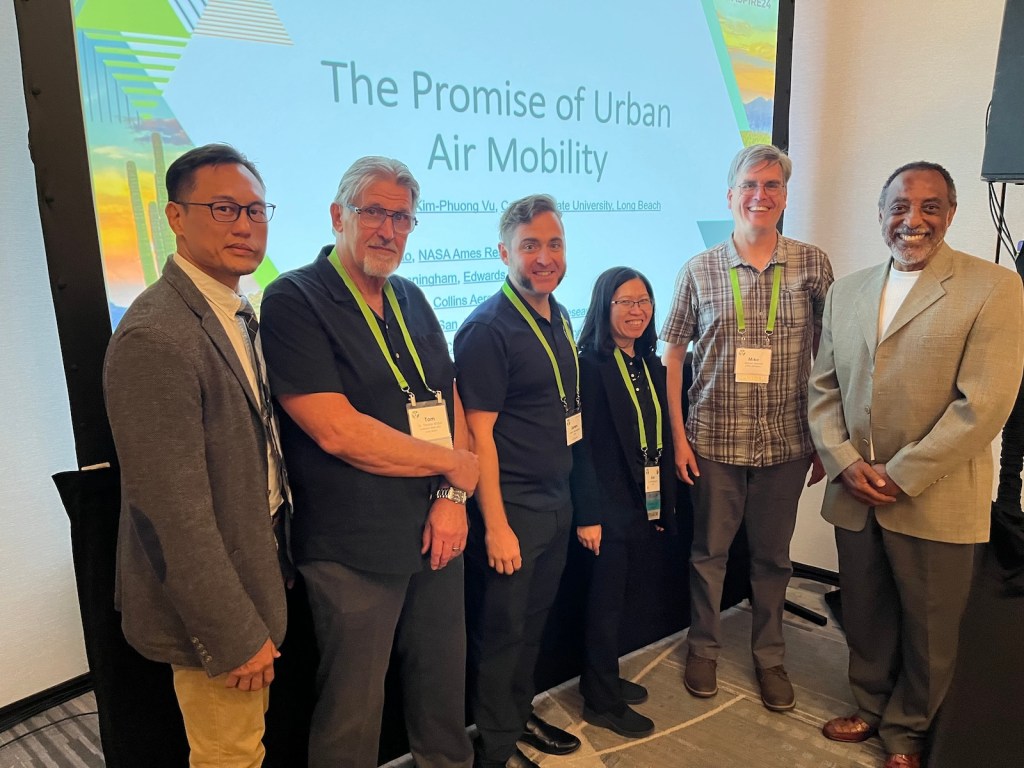
From left to right on the picture: Quang Dao, Thomas Strybel, James Cunningham, Kim-Phuong Vu, Mike Matessa, Vernol Battiste
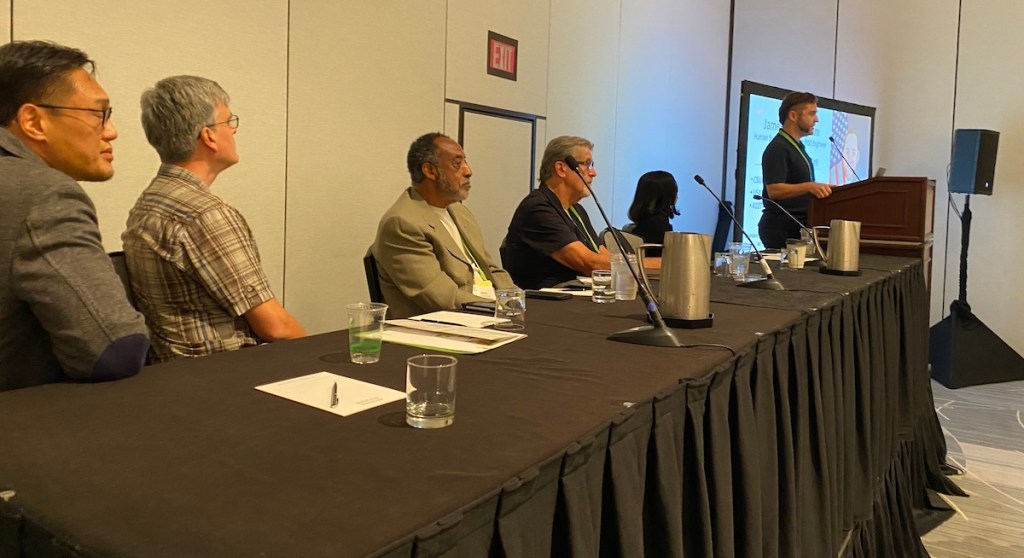
Urban Air Mobility (UAM) is set to change our industry in the coming years. The first discussion panel chaired by Kim-Phuong Vu brought together five panelists from industry, academia, and government agencies to discuss the state of UAM today and what it will take to make UAM a reality. Specifically, they addressed how the development of the major components of the UAM system should evolve over time. This article summarizes the major topics brought by each panelist in an easy to read format.
Quang Dao – NASA Ames Research Center
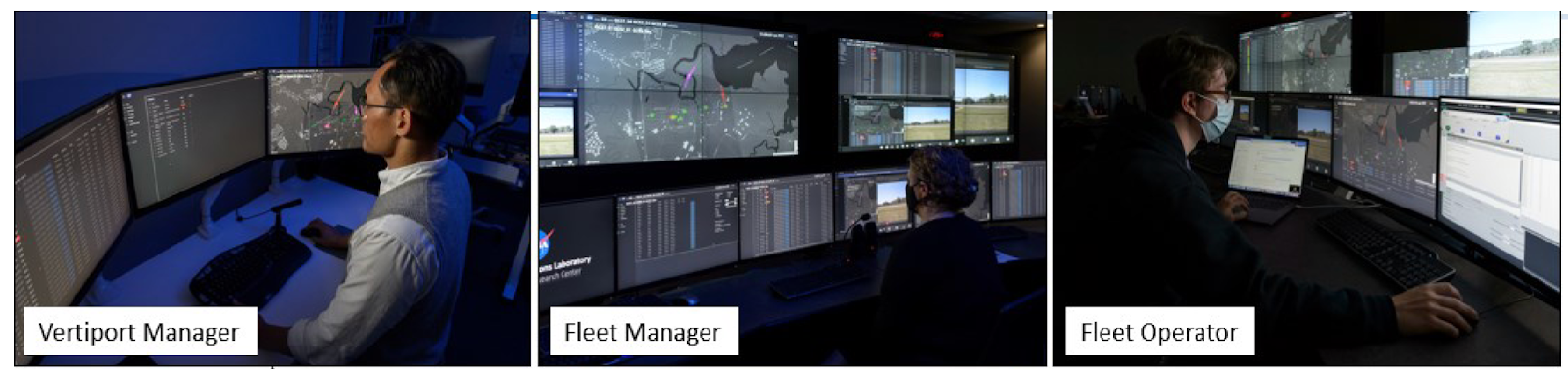
Dao highlighted NASA’s ongoing program focused on Advanced Air Mobility (AAM) and their development of a simulated work environment for high density Vertiplex (HDV). A key aspect was the explanation of three actor roles expected in UAM:
- Fleet manager is responsible for maintaining situation awareness and shared command of multiple simultaneous operations of a company’s fleet. In a recent study the fleet manager commanded between one and five operations simultaneously.
- Vertiport Manager is responsible for managing resources at the vertiport level. The manager works with automated tools for scheduling arrivals and departures and monitor movements on the vertiport.
- And the Pilot who is responsible for flying the vehicle safely to destination
Dao showed workstation prototypes developed for the fleet manager and vertiport manager to support their task and situation awareness. He also discussed a scenario where rerouting decisions due to weather or other traffic must be made and how these tools helped their decision-making. The debate is whether the fleet manager should decide on the course of action and inform the pilot, or to offer options for the flight crew to review and execute on their own. This work will guide who has the authority and information necessary for flight diversion.
James Cunningham – Edwards Air Force Base

Cunningham introduced the Agility Prime initiative, aimed at accelerating emerging dual-use technology for vertical lift markets by leveraging government resources. This initiative includes significant government investments in infrastructure and airspace to allow companies to develop and test UAM technologies. In late 2021 they conducted the first US Air Force remotely piloted eVTOL flight and in 2022 the first remote eVTOL qualifications. Agility Prime’s main objectives focus on defining UAM use cases, assessing their military utility, investigating policies and regulations, and logistics such as charging integration of eVTOL into the electrical power grid. Cunningham also noted that pilot training for UAM will likely differ from existing commercial pilots and will require further study to assess the competency levels.
Mike Matessa – Collins Aerospace
Matessa focused on increasingly autonomous vehicles and the need for rigorous verification methods during their development. He discussed the development framework put forth by his team in a recent collaborative research project along with NASA and Florida Institute of Technology:
- Requirements definition: Set the concepts of operations (CONOPS) under scrutiny ex. 1 or 2 pilots, remotely-piloted or not.
- Design and analysis phase: to is of importance to ensure the use of formal methods for verification as part of the architecture
- Implementation of an AI system (IAS)
- Verification of requirements with formal methods
Matessa explained the implementation of the system with a realistic vehicle performance into their simulation model using Soar, AMASE and nuXmv for formal language. The most interesting points exemplified were:
- the formal analysis of the IAS self-learned rules
- and having formally proved properties and Human-Autonomy Teaming given the requirements on the IAS and operator
The detailed work is available online and on a GitHub Repository.
Vernol Battiste – San Jose State University Research Foundation
Battiste’s presentation centered on Simplified Vehicle Operations (SVO) for UAM. Despite progress, fully autonomous flight is far from being realized, with certification challenges still present such as whether to use existing or new certification basis. Battiste also noted a shortage of certified pilots and suggested prioritizing ease of use in vehicle design to allow quicker pilot integration. He explained research projects underway with NASA to develop a testbed to evaluate future UAM ConOps. Battiste presented recent results of a single interceptor for flight and ground mode, along an new integrated flight display, that were found surprisingly easy to use by pilots and non-pilots. Throughout his talk, he emphasized the value of human pilots in maintaining safety and suggested that future autonomous systems should be termed “increasingly autonomous” to reflect the collaboration between pilots and systems.
Thomas Strybel – California State University, Long Beach
Strybel pointed out the overall uncertainty in the AAM space but emphasized its potential benefits, such as reducing road traffic and pollution. He discussed ongoing plans for air taxi services in Los Angeles by 2026 with Archer Aviation. However, FAA requirements are still evolving, posing significant challenges for UAM integration with the existing National Airspace System (NAS) and air traffic management (ATM). He also highlighted the need for passenger acceptance, pilot shortages, and improved communication with new roles like vertiport managers.
Questions
During the question period, Strybel highlighted the common points between all panelists was the uncertainty related to the UAM space as there remains a lot of open questions for its successful integration into the NAS.
Asked by the audience to list the main human factors challenges associated with UAM, the panelists discussed the following: Company and regulatory leadership, airspace management rules, pilot training, vehicle certification, SVO design, vehicle noise in urban areas, and importantly pilot and public acceptance.




 HFES Aerospace Systems
Leave a comment