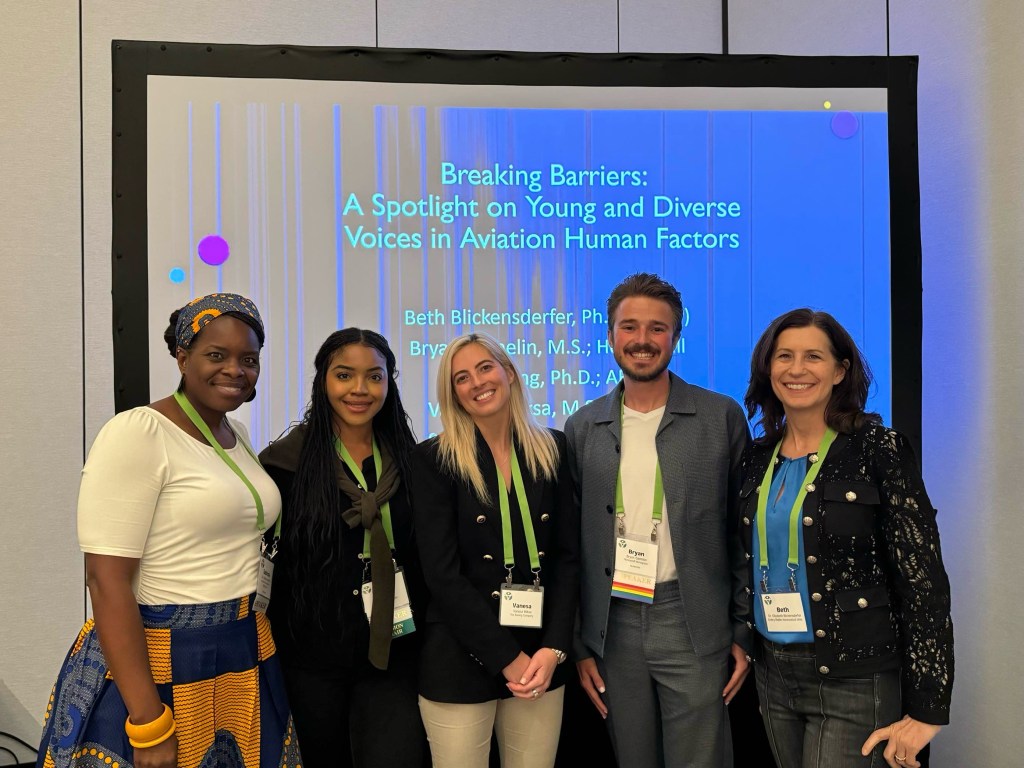
From left to right: Sabrina Woods, Jayde King, Vanessa Miksa, Bryan Gamelin and Beth Blickensderfer.
Dr. Beth Blickensderfer from Embry-Riddle brought together 4 early career professionals in aviation human factors to reflect on the changes observed in the aerospace industry. The discussion panel was a great avenue to show to young researchers the excitement and opportunities that aerospace has to offer. Each panelist briefly explained their life story and then exchanged thoroughly with the audience, sharing their perspective on how to make their way in the industry and the challenges they faced.
Panelists

Bryan Gamelin works at Honeywell Aerospace as an Advanced Human Factors Systems Engineer for Integrated Flight Systems. His role encompasses human factors activities related to the implementation of Anthem, Honeywell’s next generation touchscreen avionics, into the Lilium UAM eVTOL aircraft.
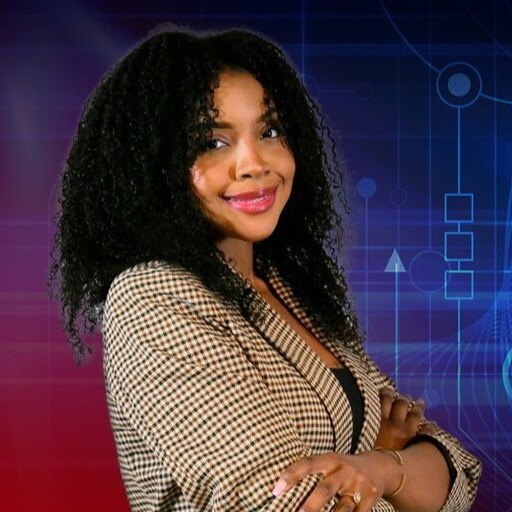
Jayde King is a research psychologist in the U.S. Air Force Research Laboratory (AFRL), focusing on co-learning and enhancing human-autonomy teaming for space applications. She works on mental model elicitation to improve interactions between humans and autonomous systems. Growing up in Florida and watching space shuttles sparked her interest in aerospace. She holds a B.S. in air traffic control and later pursued a master’s and Ph.D. in aviation human factors.

Vanesa Miksa works on future flight deck projects at Boeing. She transitioned from intern to full-time employee during her master’s studies. A licensed pilot and flight instructor, she also served as president of Women in Aviation International in Daytona Beach, FL. Initially on a path toward medicine, Vanesa switched to aviation human factors after her first flight in a Cessna 172, realizing aviation was her true passion.
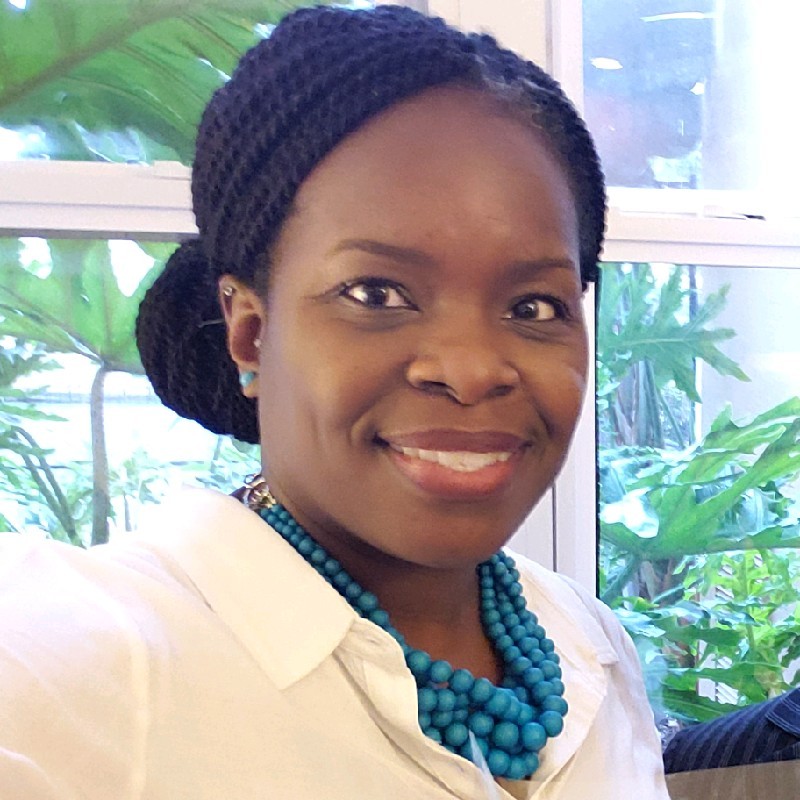
Sabrina Woods is a human performance specialist at the National Transportation Safety Board (NTSB). She began her career as a second lieutenant in the U.S. Air Force in 1998, initially working in aircraft maintenance and evolving into an accident investigator. Fascinated by human error, she pursued a master’s and Ph.D. in human factors at Embry-Riddle after leaving active duty to join the reserves. Sabrina specializes in the internal and external factors influencing performance, such as fatigue and organizational culture, and collaborates with the FAA and NTSB to investigate aviation accidents and improve safety.
Question: What advice do you have for new graduates?
Bryan Gamelin: Bryan highlighted the importance of broadening one’s skill set, saying, “Diversify your knowledge—not only theory but also practical.” He described how his daily work involves collaboration with a wide range of professionals, including psychologists, engineers, and pilots. According to him, “You need to be well-rounded to work with all those people.”
Jayde King: Jayde encouraged early involvement in a variety of projects and professional societies, stating, “Being involved in different projects helped me a lot.” Reflecting on her own journey, she said, “I was more introverted when I started, but joining these societies helped me reach out to people, which is a big part of my job.” She now encourages others to apply for positions that interest them and not shy away from their ambition. “Let the employer tell you no,” adding that “‘no’ can also mean ‘not the right time,’ so try again.”
Sabrina Woods: Sabrina reminded new graduates that career paths are often unpredictable: “People think there’s a straight line from school to the job, but it’s really not the case.” She explained that taking a side-step from her work and to return to school was a decision that greatly enriched her career. Sabrina supported Jayde’s sentiment with her own experience: “It took me three times to get hired at the NTSB, but the third interview was the charm.” Her message to new professionals was simple: “Don’t give up.”
Vanesa Miksa: Vanesa underscored the importance of networking: “Networking is essential for people to know you and for you to know about opportunities.” She recommended that students join professional organizations and student chapters to build these connections.
Jayde King: Echoing Vanesa, Jayde added, “Leverage the organization and network opportunities you have access to.” She credited the National Society of Black Engineers (NSBE) with helping her find her current job, saying, “It was central to my career.”
Question: What are the major technology changes in the industry to watch for?
Bryan Gamelin: Bryan noted the shift from mechanical controls to touchscreens in cockpits, but highlighted the challenges this brings. He explained, “A big challenge is when you integrate everything on the touchscreen, it can actually increase workload.” His team’s focus is on determining which controls should remain physical to leverage pilots’ physical memory. “There’s value in keeping some controls tactile to reduce cognitive load,” he said.
Jayde King: Jayde pointed to advancements in learning technologies, specifically mentioning the potential of large language models (LLMs). She said, “LLM is a very exciting topic, especially in how we can improve learning in space applications.” Her research focuses on co-learning systems that could enhance human-machine collaboration.
Vanesa Miksa: Vanesa, reflecting on her own piloting experience, marveled at the pace of technological advancements. “When I started flying, I had autopilot and a G1000 in my Cessna,” she shared. “Three years later, we have autoland on a Cessna, which is amazing.” She emphasized that today’s pilots are accustomed to advanced technology like ForeFlight and autoland capabilities, representing a significant shift in the industry.
Sabrina Woods: Sabrina raised a critical concern about over-reliance on technology. She said, “My concern is always when things go wrong.” While the industry is focused on making systems highly reliable, designed for the rare failure rate of 10^-9, she cautioned, “Engineers understand this as if the system can’t fail, but it can.” Sabrina emphasized that training for system failures is essential, stating, “When systems fail, pilots have to rely on their training, and it feels like we’re losing that perspective.” She stressed the need to refocus on preparing for failure scenarios.
Question: What challenges did you face when transitioning from academia to industry?
Bryan Gamelin: Bryan described the adjustment to a different pace and increased bureaucracy in industry compared to academia. “There was a lot of on-the-job training to learn about the more bureaucratic parts of the job and delays,” he explained. In academia, he noted that projects moved faster, whereas industry work often requires navigating administrative processes.
Jayde King: Jayde emphasized the steep learning curve she experienced when transitioning to a multidisciplinary team at the Air Force Research Laboratory. “I had to do a lot of research on my own, learning about subjects like computer science and cognitive modeling that I didn’t know,” she said. Another challenge was managing projects involving multiple disciplines. “I managed my own thesis, but now it’s multidisciplinary, and you have to reteach yourself to understand the measures from each discipline,” she added, highlighting the complexity of technical management in industry.
Question: Have you ever felt pressure to conform to the dominant “white male” culture in the workplace as a diversity member?
Jayde King: Jayde acknowledged the still present gender imbalance in her field. To combat feelings of exclusion, she joined the National Society of Black Engineers (NSBE), where she found mentorship and support. Being part of such organizations allowed her to feel comfortable and contribute her unique perspective at work. Jayde emphasized the importance of bringing one’s personality to the job, adding that everyone contributes a unique “piece of the puzzle,” which enriches problem-solving.






 HFES Aerospace Systems
Leave a comment