By Nick Tepylo
In 2022, Dr. Nick Tepylo, formerly of Carleton University began research into public perception of advanced air mobility. Funded by Innovation, Science and Economic Development Canada, his team developed a survey that was distributed to the canadian population to try and understand their level of awareness about drones, uncrewed aerial systems, and urban air mobility. They received over 1000 responses from the demographically representative sample which revealed several key findings. First, the term “drone” is far more recognized and is viewed more favorably than other terms such as “unmanned aerial vehicle”. When looking at an individual’s emotional response to drones and UAVs, they found that men view drones with positive feelings, whereas women are more neutral; however, with UAVs, men expressed mostly positive and neutral feelings while women showed concern.
One of the main questions in the survey asked participants if they supported drones and UAVs in all cases, were opposed in all cases, or their support/opposition was conditional on factors such as the operator, the purpose of the flight, the weather, etc. Overall, 74.1% of individuals stated that their support or opposition was conditional and based on the specific circumstances, with another 18.8% indicating support regardless of the conditions and 7.1% opposing in all cases. The next series of questions presented various applications of drones such as search and rescue, agriculture, surveillance, and package delivery. The most supported mission, search and rescue, received 87.7% support, 1.6% opposition, and 10.7% remaining neutral. When comparing the two questions, the level of opposition for search and rescue missions was far below the percentage that said they oppose the use of drones in all cases, indicating that many individuals are unaware of how drones can be used. As for the other applications, package delivery had the lowest level of support with 44.9% in favor, 25.7% opposed, and 29.4% neither supporting nor opposing this mission type. One surprising finding was that older individuals are more supportive of drones when their use case is explained in comparison with younger individuals [1]. This finding and others contained in the article suggest that educating the public is the key to widespread acceptance. The team also demonstrated that recruitment methods are important and that surveys which are not demographically representative can contain biased samples.
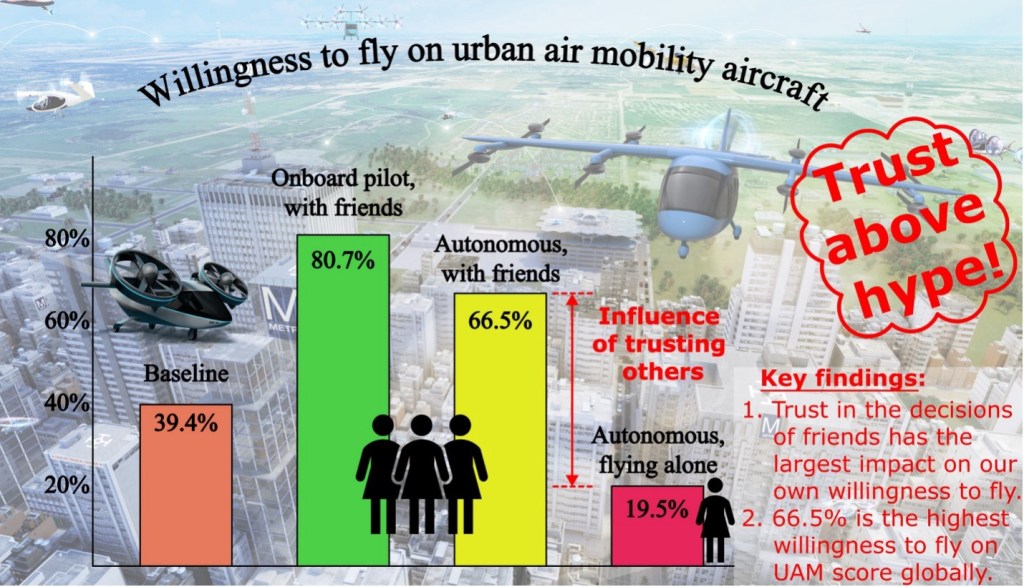
Their most recent article asked individuals if they were willing to fly on urban air mobility aircraft, finding that 39.4% of their Canadian sample were happy to do so, with another 29.1% indicating maybe. A follow-up question clarified that they could fly with a pilot and/or flight attendant on board and presented a scenario where individuals could fly with their friends or fly alone. This question demonstrated the value of trust as 66.5% of those surveyed indicated they were willing to fly onboard a fully autonomous aircraft if people they knew were also on board. This is the highest known willingness to fly on an autonomous aircraft globally.








 HFES Aerospace Systems
Leave a comment