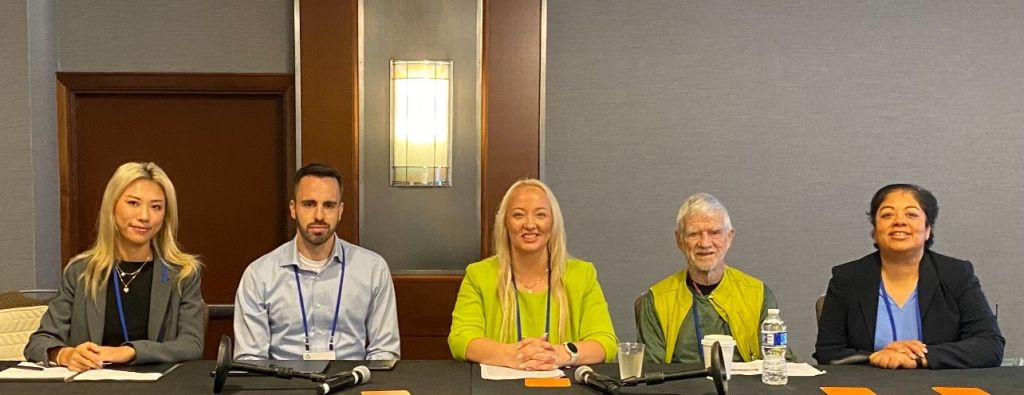
The ASTG also held an interesting panel in collaboration with the Sustainability TG on the promise of sustainable aviation. Leading HF researchers working on emerging technologies like drones and advanced air mobility (AAM) shared some of the lessons they have learned from their research in industry and academia. The panel was moderated by Shraddha Swaroop (CSULB), and included four panelists: Chris Wickens (Colorado State University), Oleksandra Molloy (University of New South Wales), Mark Shikerman (Wisk Aero) and Yining “Elena” Zhang (Rice University).
Chris Wickens – Pilot Information Processing and Display Design
Chris Wickens opened the panel with a discussion on the visual challenges of clutter in the use of head-mounted displays (HMDs). Dr. Wickens explained how clutter can inhibit a pilot’s ability to monitor mid-air and off-axis targets, as well as HMD-critical flight parameters and map information, and discussed his research applying computational models to quantify the maximum amount of clutter for HMD screens using objective clutter metrics. He also discussed his research on hazard cueing, which was aimed at identifying the most effective augmented reality 3D cues for ground operations and examining the issue of automation bias when the AI machine vision is infrequently and unexpectedly wrong.
Oleksandra Molloy – AI-Based Approach for Assisting UAV Operators’ Training
Oleksandra Molloy followed with a discussion of the Defence Trailblazer pilot study, which aims to understand the relationship of cognitive load, situation awareness, and performance for Uncrewed Aerial Systems (UAS) operators. Her research was also aimed at developing AI-algorithms and machine learning techniques to assist in monitoring and predicting cognitive load for UAS operators, that will assist mission aviators in improved SA and decision making while operating under various levels of cognitive load. She walked the audience through the experimental setup in a UAS simulator, the physiological metrics obtained as a result of the study, and the AI approach for cognitive load assessment. She closed out with key takeaways about how AI-assisted training within an adaptive learning approach can improve performance, reduce time spent on training, and increase situational awareness for the trainee.
Mark Shikerman – Operator Performance for Handling Multiple Vehicles With Multiple Missions and States
Mark Shikerman described how the HF team at Wisk is building and testing their Multi-Vehicle Supervision System that humans will use to supervise multiple aircraft simultaneously. Specifically, he talked about how Wisk is analyzing and collecting data on operators’ performance in different scenarios that include multiple missions in different states, and is evaluating how automation can assist with the safe and efficient completion of required tasks. As a developer of a commercial product, Mark also touched on how Wisk is leveraging the lessons learned from their HF research to develop a novel system that can meet the requirements necessary for certification and safe operation.
Elena Zhang – Drone Operator Decision Making
Elena Zhang closed out the panel with a discussion of her research into drone operator decision-making in an architecture where one operator supervises multiple drones simultaneously. She described their experimental setup where operators supervise several subtasks that a simulated fleet of drones is performing simultaneously. She then discussed their results, which illustrated how workload affects automation usage and found self-confidence, rather than trust in automation, to be a more significant mediator of that effect.







 HFES Aerospace Systems
Leave a comment