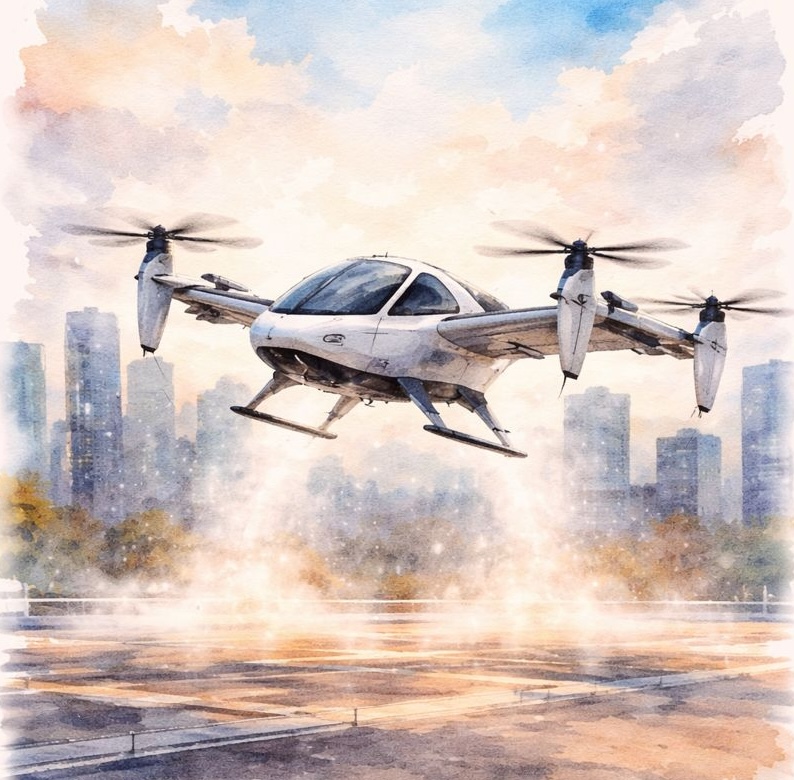
Just before the holidays, the U.S. Department of Transportation (DOT) unveiled the first Advanced Air Mobility (AAM) roadmap to accelerate aerospace transformation. This roadmap is the outcome of nearly three years of work, following a Congressional mandate for the DOT to convene an Interagency Working Group (IWG) to define a national AAM strategy for the coming decade. The IWG brought together more than 100 experts from 25 federal agencies, and the roadmap represents a consolidated view of their collective efforts. The roadmap also provides a high-level timeline for AAM deployment: initial operations around 2027, expanded urban and rural eVTOL operations by 2030, and the introduction of fully autonomous operations by approximately 2035.
The AAM roadmap actually consists of two documents: the strategy and the plan. The Strategy sets the policy vision of the United States and formulated 40 recommendations. The Plan details how federal agencies will execute those recommendations over time. Both documents are well worth reading for anyone interested in anticipating how the National Airspace System may evolve over the next several years.
The strategy frames the AAM integration around six pillars (Airspace, Infrastructure, Security, Community planning, Workforce and Automation) and identifies policy and research priorities to make it happen.
From a human factors perspective, the most note-worthy recommendations are:
Airspace
- Airspace management is expected to evolve towards “cooperative areas” where multiple service providers will be able to operate within defined portions of airspace under shared rules and responsibilities.
- Develop new surveillance solutions for low-altitude, high-density operations, along with new communication protocols that move beyond traditional voice radio exchanges.
Infrastructure
- Strong emphasis is placed on adapting existing infrastructure and regulations to accommodate new AAM entrants, while investing in technologies that overcome the limitations of decades-old aviation systems.
- Identify facility and equipment requirements at airports for remotely piloted, supervised, and autonomous AAM aircraft, recognizing that current guidance was never designed for these operational concepts.
Workforce
- Develop new educational and training programs to prepare for the new jobs expected by AAM. Previous UAS workforce studies identified: 35 occupations related to pre-operations/design, 17 related to operations, and 31 occupations in which UAS are utilized as a tool on the job.
Automation
- Federal agencies will research human–machine interaction and role allocation in highly automated and autonomous aviation systems, including performance during off-nominal and degraded conditions.
- Assess the risks and implications of coexisting pilot training models (e.g., hours-based and competency-based), including challenges associated with transitioning between them.
The AAM roadmap was well received by the industry, with AIN reporting that the major eVTOL players applaud the U.S. government for taking a strong position on AAM in the country.
The AAM strategy and implementation plan lay out a strong vision for research and infrastructure development over the next decade. We will continue to monitor progress and report on key developments as they emerge.







 HFES Aerospace Systems
Leave a comment