ASTG Officers 2026
By Nayara Faria, ASTG Chair
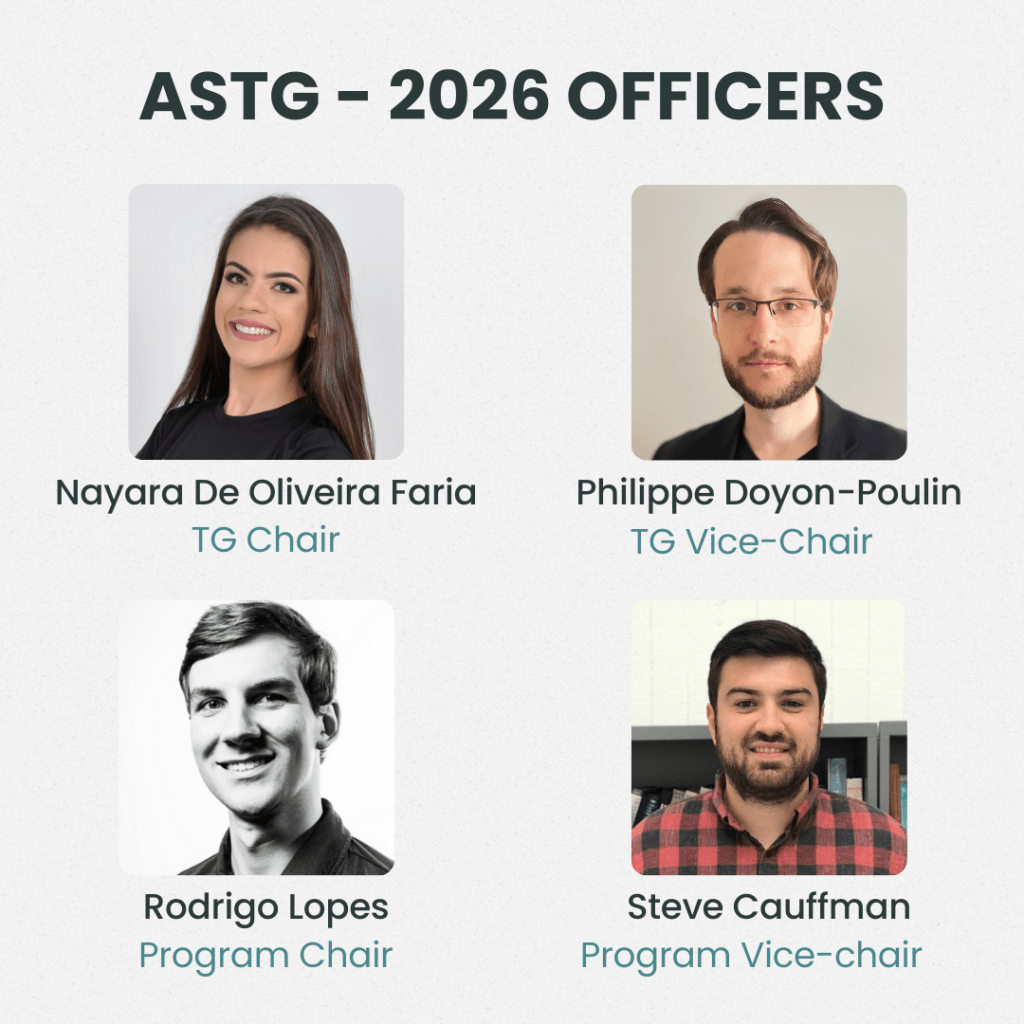
We are pleased to announce the newly elected officers of the Aerospace Systems Technical Group (ASTG). This leadership team brings a wealth of experience across human factors, flight deck design, certification, automation, and safety-critical systems. Together, they represent a strong balance of academic research, industry practice, and technical leadership that will guide ASTG’s work in the coming term.
Chair – Nayara Faria, Boeing
Nayara Faria holds a Ph.D. in Human Factors from Virginia Tech, where she investigated a safety-centric evaluation framework for augmented-reality head-up displays. She has previously interned at Google as a UX and Human Factors Researcher. Currently, Nayara is a Human Factors Engineer at Boeing, supporting flight deck certification activities aligned with FAA regulations 25.1302, 25.1309, and 25.1322. Her work integrates research rigor, certification requirements, and human-centered design to enhance safety in aerospace systems.
Vice-Chair – Philippe Doyon-Poulin, Polytechnique Montréal
Philippe Doyon-Poulin’s research focuses on the design and evaluation of control centers for complex systems, with emphasis on human factors in aviation. Prior to his academic career, he worked in flight deck design and certification at Bombardier Aerospace, contributing to the certification of the CSeries and Global 7500 programs in accordance with regulations 25.1302, 25.1309, and 25.1322.
Program Chair – Rodrigo Lopes Rose, BETA Technologies
Rodrigo Lopes Rose is a Safety Systems Engineer at BETA Technologies, where he supports the development and integration of safety-critical systems for next-generation aerospace platforms. His professional background brings a strong systems-engineering and operational safety perspective to ASTG’s technical programming.
Program Vice-Chair – Steve Cauffman, Ph.D., Boeing
Steve Cauffman serves as the Autoflight Human Factors Technical Lead at Boeing. His work includes generative evaluations for new takeoff alerts, task analyses of pilot interactions with automated systems, and cross-functional collaboration to support human-centered design and testing. Steve has authored human factors process improvements for error analysis, developed human-centered design principles for flight deck automation, and provides mentorship and technical leadership to early-career human factors engineers.
We congratulate our new officers and look forward to a productive and impactful term under their leadership as ASTG continues to advance human-centered approaches to aerospace systems.
Membership Renewal – Last chance
If you haven’t renewed, this is your last chance to renew your ASTG and HFES memberships. After January 31, you will lose access to the ASTG user forum, our information-packed monthly newsletter and all the benefits of active HFES members. We hope you’ve found value in the Aerospace Systems Technical Group’s activities over the past year and that you’ll continue to be part of our community in the year ahead.
Check your membership status: https://my.hfes.org/my-account/my-profile
Renew your membership: https://my.hfes.org/become-a-member
Please note that ASTG and HFES memberships are managed independently. You may be a member of ASTG without being an HFES member, and vice versa.
ASPIRE conference

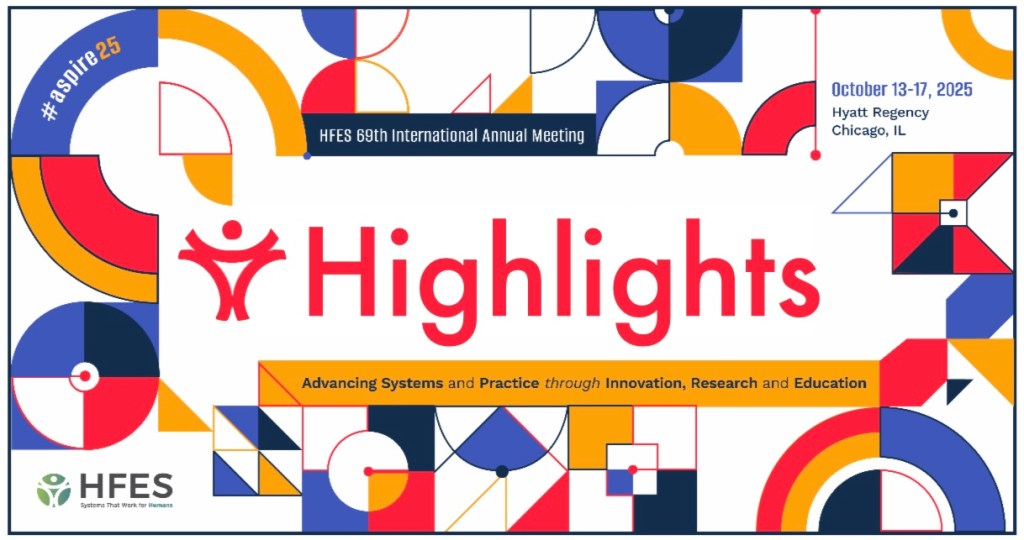
The next HFES conference will be held in Reno, NV on October 19 – 23, 2026.
The call for papers is now open and you can submit your extended abstract up to February 16.
You can submit one of the following communications:
- Lecture (research paper that describes recent empirical, theoretical, or practitioner work)
- Poster (unique opportunity to interact one-on-one with attendees in an open, dynamic setting)
- Panel (talk with up to six panelists followed by discussion involving the audience and panel members)
- Case Study (real-world applications, experiences, and lessons learned from the industry)
- Demonstration (brief oral presentation followed by a live demonstration of a tool or product)
- Workshop (3h or 6h training session on Monday)
- Alternative Format (ex. debates, on-site experiments, simulations, and other innovative approaches)
ASPIRE adopts a 2-step submission process for presentation at the conference and then publication in the conference proceedings. The first step requires a 2-page extended abstract for most submission types. Acceptance at this stage grants authors the opportunity to present at ASPIRE. Then, authors may decide to optionally submit either a revised extended abstract or a 5-page paper for consideration for publication in the proceedings. Acceptance for presentation does not automatically grant acceptance for publication in the proceedings.
To present as part of the Aerospace track, make sure to select Aerospace Systems as your primary technical area in the list.
Recent publications
Mitigating inadvertent transitions from visual flight rules to instrument meteorological conditions in general aviation: decision-making strategies, cognitive challenges, and training Implications from an applied cognitive task analysis
Jiwon W. Kim, Michael C. Dorneich, Eliot Winer, Lori J. Brown & Geoff Whitehurst
Ergonomics
The evolutionary de-crewing of airline cockpits: a historical and analytical perspective
Konstantinos Pechlivanis & Dimitrios Ziakkas
Theoretical Issues in Ergonomics Science
Training effectiveness and validation of a VR HMD-based simulator for air force pilots
Ramy Kirollos, Wasim Merchant, Blake C.W. Martin, Jerzy Jarmasz & John Jong-Jin Kim
Ergonomics
The use of artificial intelligence (AI) in the flight deck: Enhancing human-AI teamwork in aviation
Jenna Korentsides, Elizabeth R. Merwin, Lila Berger, Lana Laskey, Scott R. Winter, Briana Sobel, Joseph R. Keebler
Journal of the Air Transport Research Society
Using heuristics to glide an Airbus A320 following all-engine failure in cruise: a simulator-based experimental study
Cristian Mandu, Anthony Smoker, Petru Lucian Curșeu
Ergonomics
Pilot response to somatogravic illusion in a simulated environment: Implications for early instrument flight training
Vladimir Socha, Lenka Hanakova, Boris Oniscenko, Robert O. Walton
Applied Ergonomics
Goal trade-offs in air traffic control
Donald Gyles & Chris Bearman
Theoretical Issues in Ergonomics Science
A Comparative Study of Cognitive Abilities of Generation Y and Generation Z Pilot Candidates
Aldona Radzeviciene, Darius Rudinskas & Vytautas Rimsa
The International Journal of Aerospace Psychology
Exploration of interaction modality for civil aircraft flying task: A laboratory study
Rourou Yu, Youchao Sun, Chaochao Guo
International Journal of Industrial Ergonomics
U.S. DOT Advanced Air Mobility Roadmap
We wrote an in-depth look at the U.S. DOT Roadmap for Advanced Air Mobility. Read it on our blog.
In the news
ATM
FAA Selects Collins Aerospace and Indra for Radar and Radio Replacements. One of the first major announcements made by Peraton that is managing the US ATM system overhaul is the replacement of 612 ground-based radars by June 2028. The FAA awarded $438 million to Collins to install the Condor Mk3, a cooperative surveillance radar using the aircraft transponders, along with the ASR-XM, a non-cooperative radar that detects aircraft using reflected signals. Indra Group USA also received $342 million as part of the FAA’s Radar System Replacement program, although the press release does not mention the technology it will deploy. In November, Indra got $244.3 million to install 46,000 new radios.
Electric
Wisk flies first Gen 6 eVTOL, bringing autonomous air taxis closer to launch. During its first flight in Hollister, CA, the aircraft performed its initial vertical takeoff, hover, and stable flight maneuvers. Wisk Gen 6 is a fully electric and autonomous vehicle (no pilot), with specialized human supervision from a ground-based Multi-Vehicle Supervisor. Wisk aims to become the first autonomous passenger aircraft to achieve FAA certification for commercial operations in the United States, with planned launch cities such as Houston, Los Angeles, and Miami.
Boeing-backed EVIO launches hybrid-electric regional airliner with 450 orders. On December 11, EVIO launched its EVIO 810 regional airliner: a clean-sheet design, hybrid-electric power with 76 seats. Entry into service is planned in the early 2030s. The startup can count on heavy players in the aviation industry to give itself a leg up: Boeing offers engineering support, and Pratt & Whitney leads the propulsion system development and plans to use the PT6E engine as the core of the hybrid architecture. EVIO says it has received 250 orders and another 200 options from two undisclosed “major carriers”. The company also plans for military and cargo variants of the aircraft.
UAM
Air Force Research Laboratory (AFRL) plans to award up to $499 million in counter-small unmanned aircraft system (C-sUAS) research contracts over the next five years. Their goal is to develop cyberspace countermeasures that disrupt sUAS operations, particularly command and control links. This includes improving system resiliency in contested environments and prioritizing low-collateral damage solutions. Command and control advancements aim to automate and optimize responses to sUAS threats, especially swarm attacks. The contract opportunity is available online.
Space
Space Force Association unveils virtual National Spacepower Center. The Space Force Association, a nonprofit organization, unveiled a decision theater for education and analysis designed to strengthen U.S. leaders’ understanding of space as an operational military domain. The technology is developed by Sedaro, a company specializing in simulation and visualization capabilities. Sedaro demoed the platform on Dec. 11 at the Spacepower conference to an audience that included senior leaders from the U.S. Space Force. The platform is intended to enable interactive exploration of spacepower concepts, facilitate strategic wargaming, deliver immersive learning experiences, and provide a testbed for evaluating new approaches to space strategy and policy.



 HFES Aerospace Systems
Leave a comment