Elena and Philippe started a regular segment to share the latest in aviation human factors as part of the Human Factors podcast. This week they talked about the ATC modernization happening in the U.S. We share the video recording and their transcript to your benefit.
(Elena) Thanks Nick and Barry. This is Elena Zhang and I’m joined by Phil Doyon from the Aerospace Systems group at HFES. So after our last recording, we started talking about the overhaul of the US Air Traffic System and all the changes happening right now. And it was just so fascinating. So today we focus our discussion to bring listeners up to speed on air traffic management.
(Phil) On January 11, 2023, all U.S. flights were grounded or delayed nationwide for close to two hours. It was the first time since 9/11 that the FAA issued a nationwide ground stop in the country. What happened? During a scheduled maintenance of the computers running Notice to Airmen system (or NOTAM), one employee mistakenly “replaced one file with another”, corrupting the database. This led to the outage of the NOTAM system, which provides advisories to aircraft pilots about potential hazards along their flight route and airports. With the NOTAM system down, the FAA grounded all flights to ensure safety.
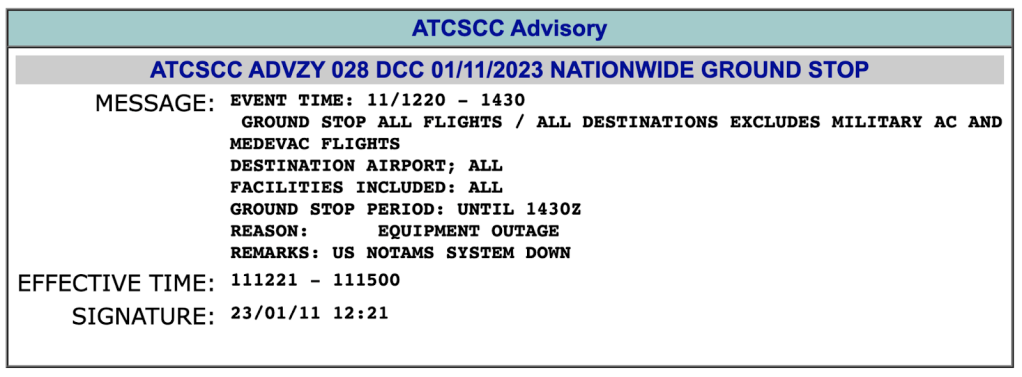
(Elena) It’s surprising that moving one file could disrupt the entire air traffic system. It took close to two hours to fix the error. From a human factors standpoint, if a file location is that important, shouldn’t the system be designed so that this type of user action is not allowed? That is something to consider.
(Phil) Then, in May of 2025, The Denver En-route center suffered a 90-second communication and radar blackout. To be clear, aircraft continued flying their assigned route during that time, but ATC could not reach pilots to give them a new clearance. Similar blackouts occurred days before at Newark Airport. The blackouts were the result of faulty radio transmitters that failed one after the other – the primary and the backup. During the Denver incident, a controller used a guard line, that is usually used for distress call, and reached one aircraft to inform them about the loss of communication at the center. That pilot then broadcasted to the other aircraft, instructing them to change radio frequency to reach an operating center.
(Elena) Wow, I was not aware of how it unfolded. So, to better understand the problem, can you tell me what the current state of ATC in the country is?
(Phil) I want to be clear, Air traffic management is safe and working in the country, no doubt about that. And everyone is committed to safety, that is controllers, pilots, airlines, etc. But ATC is facing two issues. One is infrastructure and the other is workload.
About Infrastructure. Following the NOTAM outage, the FAA was tasked to conduct a risk assessment to evaluate the sustainability of all ATC systems. For example NOTAM, is such a system, as “Electronic Flight Strip” or “Weather information”.
The report was released in September of 2024 by the Government Accountability Office (GAO). Its title was unequivocal: FAA Actions Are Urgently Needed to Modernize Aging Systems. I remember it vividly because I’d had just started the newsletter for the Aerospace System at HFES at the time and it was one of the first news that I covered.
And I was shocked by what I’ve learned.
Out of the 138 systems surveyed, they identified that 76% of them are unsustainable or potentially unsustainable, meaning that they have outdated functionality, a lack of spare parts, or if an update is available, there is no funding to support its acquisition. What is more concerning, is that 58 of those systems are considered to have critical operational impacts on the safety and efficiency of the airspace if they were to fail. This is what happened with the NOTAM system that we talked about earlier.

(Elena) That situation has gone on for a while, and the FAA is aware of it. Their problem is with funding. Over the past 15 years, the FAA’s budget for ATC infrastructure has remained essentially flat at approximately $3 billion per year, meaning they were unable to upgrade equipment across the country. You can look at the FAA’s report. They share pictures of their work environments, using fans to cool an old radar system, using aluminium foil and wrapping it around ribbon cables to reduce interference. Some systems even use floppy disks to share files between computers running on Windows 95.
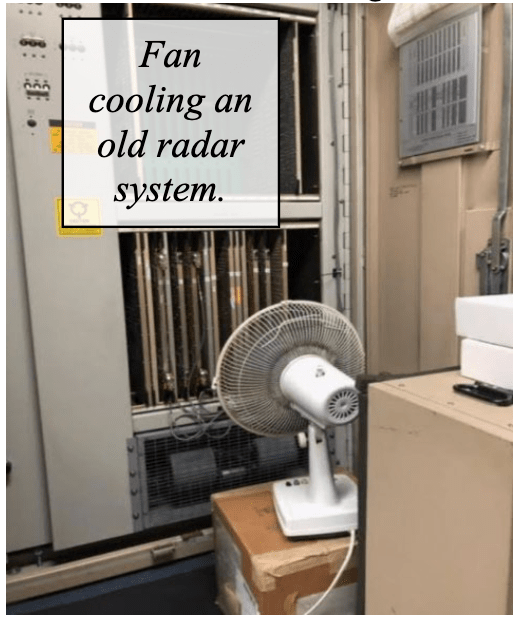
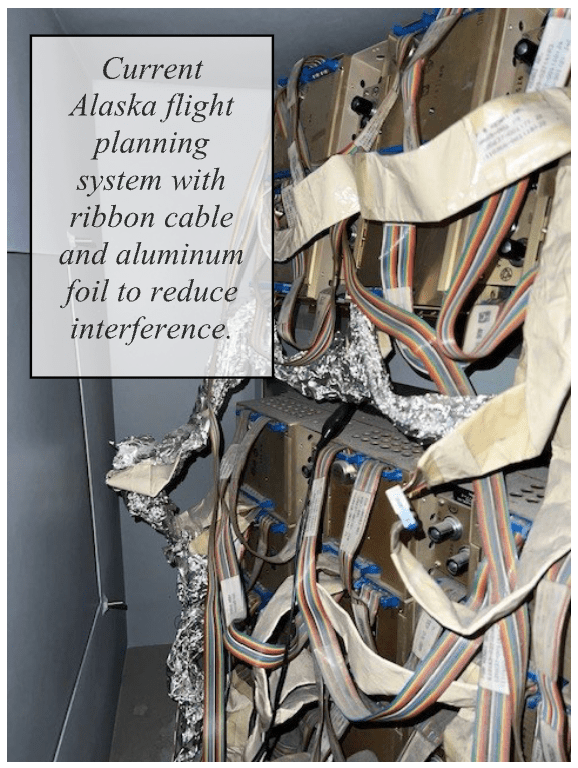
(Phil) When your operations rely on using floppy disks and Windows 95, that’s an unsustainable system. For people watching online or if you go over the Youtube channel, we present pictures taken from the reports for you to see. Clearly there is an infrastructure deficit. And what about air traffic controllers? I imagine that working in such an environment must be a challenge for them.
(Elena) ATC workforce is facing significant strain due to staffing shortages, high workload, and demanding work schedules. There were just over 14,000 controllers in 2024, but close to 7,000 of them are expected to depart by 2028. That’s half of the controllers, within 4 years.
To mitigate this, the FAA plans to hire 9,000 new controllers by 2028, offering incentives such as educational support and a $5,000 graduation bonus. Although the FAA has expanded training beyond Oklahoma City to additional centers, including Embry-Riddle, training remains highly demanding, with a 26% dropout rate. This underscores ongoing human factors challenges related to fatigue, training burden, and workforce sustainability.
(Phil)So let’s circle back to the ATC overhaul that is happening. In May of last year, the US government announced that it will replace the current air traffic control system. This program is called “Brand New Air Traffic Control System (BNATCS)”. It has a budget of $12.5 Bn and three years to make major changes. It will replace their copper analogue cables to bring-in fiber optics and high-speed internet connection. It will replace radios for VoIP to prevent issues reported previously. It will also install ground surveillance radars at more than 200 airports.
It’s a very ambitious program and will need to move at a fast pace. And this is only the first part, as the Secretary of Transportation Sean Duffy already announced that ATC modernization will need an additional $20 Bn to complete the work. So this first part is to show to congress that they can deliver before asking for the next $20 Bn
(Elena) I’ve read that Peraton was named the “Prime system integrator” for this modernization, but I’ve never heard of them before. Who are they?
(Phil). It’s totally normal that you haven’t heard of them, since Peraton came into existence less than 10 years ago. In 2017, Veritas Capital, an investment firm based in New-York, bought Harris’government IT service division, and renamed this Peraton. At the time, Harris was responsible for ATC IT infrastructure, but that division was not sold to Peraton. Peraton has continued growing by acquiring other business units in the areas include space, intelligence, cyber, defense.
(Elena) Sounds like a fast-growing business. What else have they done so far?
(Phil) Peraton was not involved in previous projects related to ATC. Their role as “prime system integrator” of BNATCS is to steer the entire acquisition program and to allocate contracts to suppliers. One of the first major announcements made is the replacement of 612 ground-based radars. Collins was awarded $438 million to install two types of radars: The Condor Mk3 is a cooperative surveillance radar, meaning that it uses the aircraft transponders to locate its position on ground. For aircraft without transponders, they also installed ASR-XM, a non-cooperative radar that detects aircraft using reflected signals. Indra Group USA received close to $250 million to install 46,000 new radios. So things are already moving. The FAA announced that their contract with Peraton will be made available on sam.gov website, but I have not seen yet, so we’ll keep you posted when it becomes public.
(Elena) Today, we explored the current state of U.S. air traffic control, from recent system outages to broader challenges posed by aging infrastructure and workforce strain. You know, that reminds me of something that Adam Lary, fellow human factors professional, said following the announcement of the ATC modernization: Beyond installing new equipment and infrastructure, we also need to consider training for the new equipment and how it will change operations on both sides (ATC and pilots). ATC modernization is really a system-wide change, and it’s an exciting time to observe its development.





 HFES Aerospace Systems
Leave a comment