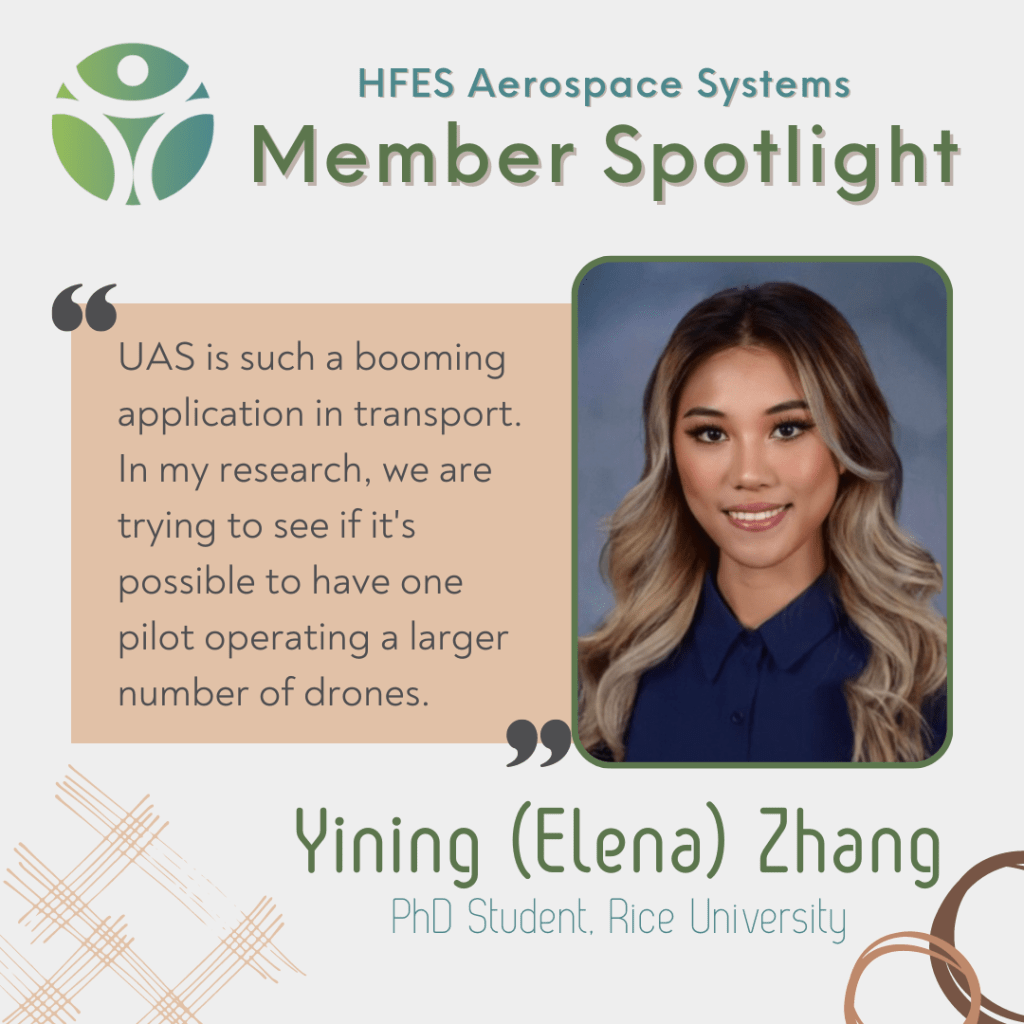
Yining (Elena) Zhang is a PhD student at Rice University working on multi-drones operations for package delivery in Dr. Jing Chen’s Human-Automation Collaboration (HAC) Lab. In this interview, she tells us more about her research and how it will influence the future of human factors in aerospace.
Can you tell us more about your research project?
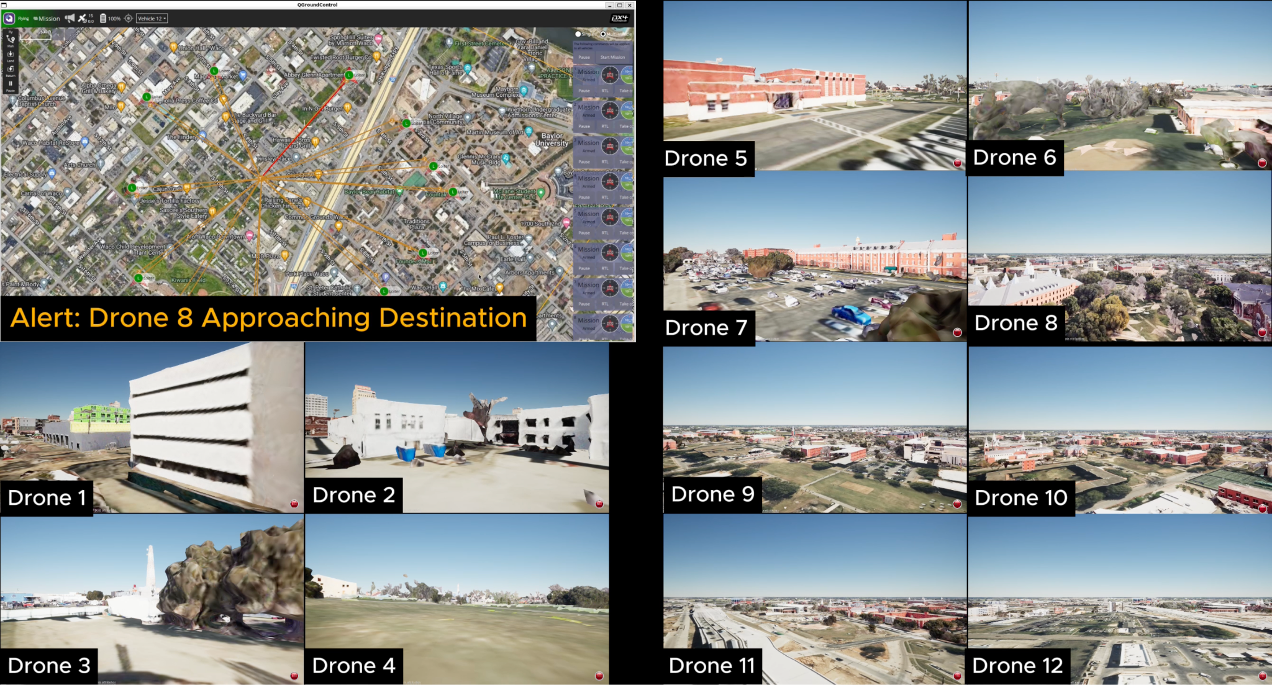
I am working on a three-year project funded by NASA, and we are at the end of the first year. There’s still a lot more to be done. The essence of the project is to explore the potential of having one person or a small group of people operate a larger number of drones, especially given the booming application of UAS in transportation and package delivery. We’re collaborating with NASA researchers as part of the m:N initiative, engineers from the University of Houston and Baylor University.
In multi-drone operations, there are many decisions to be made about which tasks need to be automated and which should be manually operated. We aim to understand the factors that influence these decisions and determine if managing a large number of drones would be too overwhelming for the operator.
For our study, we use a package delivery task in suburban areas as a testbed. We’ve segmented the entire delivery mission into five subtasks: safety planning, which includes geofencing for the drones; route planning; delivery monitoring, where the operator uses a camera to ensure safety; and finally, the drone’s return to the hub. Each subtask has many small steps, and we’re trying to identify which characteristics of these tasks make them suitable for automation or manual operation.
In our paper for AIAA, we described data from 10 expert participants in the Houston area. Our expert participants showed a strong preference for automation in both performing and assigning the subtasks of a delivery mission, and trust seems to be the most important factor. Now, we’ve collected data from a total of 20 expert participants and 20 students with no drone experience. We’re comparing the preferences of experts and novices to see if there’s a difference. We are still analyzing the data and don’t want to make any definitive statements yet.
What do you find the most surprising when you think of your work on UAS?
I am surprised by how fast technology is evolving. Just this year, Wendy’s started drone delivery in Virginia. The same goes for our research project. When it started last year, we had to build everything from the ground up, to manage a fleet of 6 to 12 drones. Now there exist more simulation platforms and software to do that.
Are you involved in HFES?
I’m actually involved in two technical groups right now. One is the Aerospace systems, and the other one is for Surface transportation; I’m their LinkedIn social coordinator. Additionally, I’m active in the HFES student chapter at Rice University. One of our key activities is inviting former Rice students to give seminars and talks, which is incredibly helpful for career advice. We also organize pizza gatherings every semester, where professors who are HFES members interact with students. These events are open to students from other departments as well.
HFES ASPIRE is just around the corner. Can you tell us more about the work you will present there?
I’m involved in two presentations. One will be on the NASA project I’m currently working on. The other presentation is a project I worked on with my colleagues about phishing alerts. We want to see how using auditory alerts helps users distinguish phishing emails, particularly for people having vision deficits or who are not actively looking at their screens.
What do you like to do to free up your mind?
I am part of a running club and we run 3 miles, but that’s actually very hard considering Houston’s humidity! I am also really into kickboxing and martial arts.






 HFES Aerospace Systems
Leave a comment