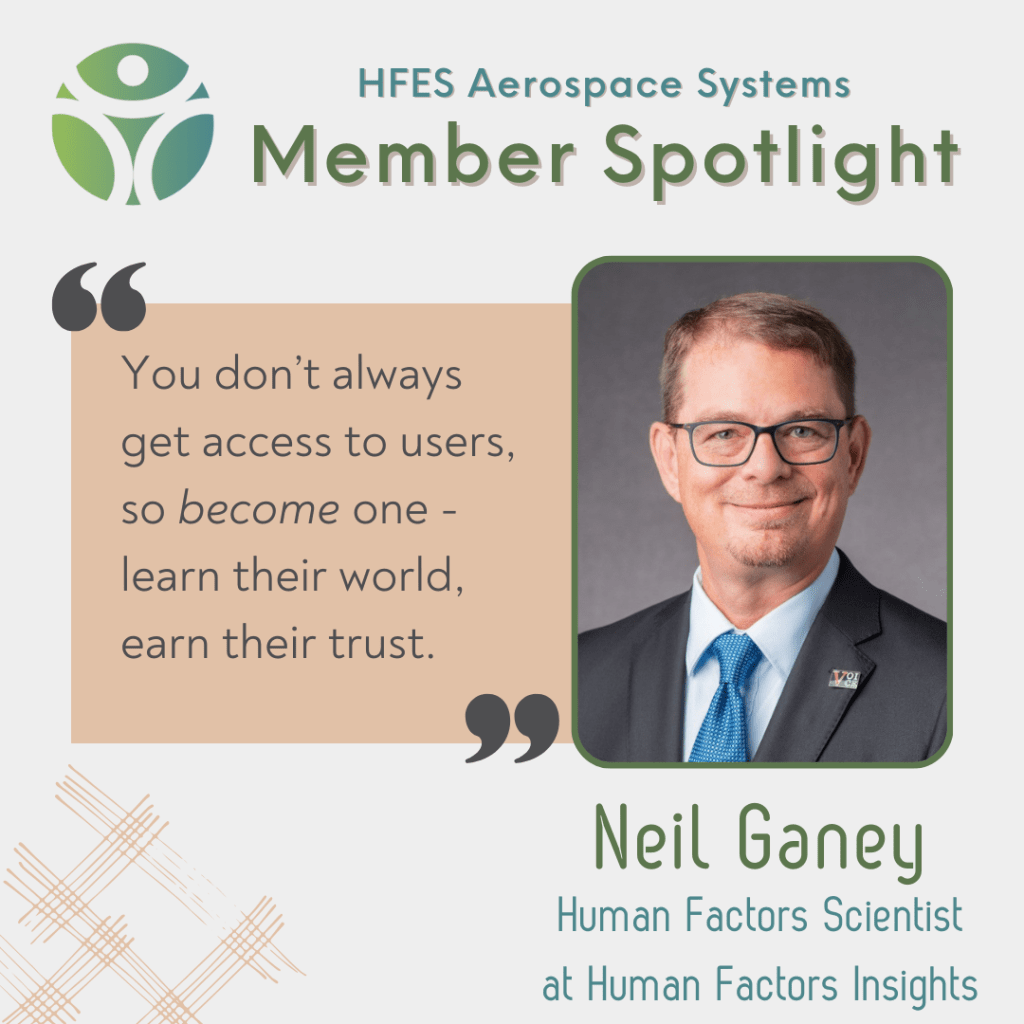
From academic foundations to classified government projects and now expert consulting in forensic human factors, Dr. Neil Ganey’s journey highlights a deep commitment to meaningful work and adaptability across domains. With broad experience from aviation and maritime systems to military wearables and safety investigations, he emphasizes the importance of understanding workplace culture, seeking impact, and knowing when it’s time to pivot. Dr. Ganey shows how human factors can drive safety, fairness, and innovation when paired with deep user understanding and organizational insight.
— By Katie Sabo
Tell us a bit about what you do at HF Insights.
We provide scientific and forensic consultant services for civil litigation. My partner, Justin Morgan, started Human Factors Insights and his focus is surface transportation, so I am bringing breadth in aerospace and maritime expertise.
My last role – the NG Fellow for Human Systems Engineering & Integration at the Northrop Grumman Corporation – I was expected to be in the office. It was a 9/80 shift schedule and the majority of work had to be in physical spaces. No tele-work was available because a lot of our work was classified. You knew pretty well what was coming. Occasionally there was a curveball problem, but you generally had a pretty good idea of what you’re working on.
Now, I have a lot more flexibility. I can get ready, take my son to school. I haven’t had a typical day since starting this; it’s been all different. I’ll go out and do site inspections, collect imagery data there, and conduct different analyses. There’s a good chunk of time I’ll work from home or go to sites, converse with attorneys, will be called into depositions – it’s a lot more variety.
What was your path to your current role?
I probably spent too long in school. If you want to go into industry and get a PhD, take some time either after your bachelor’s or master’s to work in industry, I stress that a lot with my mentees.
After school, I got a consulting role. That was a very valuable experience, and I learned a lot. That fed into being with IBM/Lenovo doing HF and usability in hardware/software. It was a great company, and I got to do lots of good stuff. But I had been working on something for nine months, we worked really hard on it, and the executives decided not to go forward with it because it would cost two cents per unit and they didn’t think the benefits would be worth it.
I wanted to have more impact, so I went to the Navy. I worked on small, high-speed boats, which let me have lots of impact in multiple ways. I loved that job and the people that I worked with. But we wanted to get back closer to our family, so when the NG role opened up, I took that and was there for 8.5 years.
I started as a staff level engineer and was promoted three times. For at least two of those, I was in the right place at the right time. I had been keeping a template for the Fellows application filled out and I would update that every six months. Most applications for promotion utilize chunks of that which scaffold on each other – it helps to keep a running Fellows app, then pull from that as you go. Ultimately, I went to HF Insights for a change. They do engage in HF, but they don’t need someone to innovate, at least not at that level I was at. It was also the company I had been with the longest, and I felt overdue for a change.
I knew Justin (my partner in HF Insights) from back when I was a grad student – I actually got him involved in HF. It was my first presentation, and I presented a poster at the Southeastern Psychological Association (SEPA) conference. I started doing a little work with him in May 2024, then really got involved in November 2024. The forensics work wasn’t altogether foreign to me, though. I’d had the opportunity to do some of this work supporting Dr. Mike Wogalter back when I was living in North Carolina. He is NC State Faculty and has a forensic practice focusing on warnings and alerts.
Can you speak more about why you suggest taking time to work in industry before going for the PhD?
In industry, knowing the education part is fine – they need to know you can work and work in that sort of setting. If you come out with a PhD and can’t play well with others, that’s a whole lot of money to be on the hook for and not work out, from the company’s perspective.
Particularly when going to work between your bachelor’s and master’s, many companies will pay for your master’s degree. You’ll get your master’s and work experience, so it is not really a time loss. Master’s coverage should be written out in your benefits package. Larger companies almost assuredly will have that. Smaller companies, maybe not. There’s tradeoffs of experience in smaller companies. You may get a larger role in projects that could be very beneficial. You need to make sure those are on your resume, and you can use them as talking points for interviews – “I had this role, this is what I did.” We’re bad at talking about what we individually did rather than collectively, but people who are interviewing want to hear about you individually; they want to know more about what you did.
Summer internships are good to help you figure out what you want to do, help start relationships, but a lot of places don’t count that towards work time. Not all internships are the same – for example, Honeywell had a really good one that was a yearlong – but by and large, they don’t count the same.
Do you have a favorite project you’ve worked on?
I’ve done a lot of cool stuff over my career. One of the coolest was when I was part of a team tasked with designing a real-life Iron Man suit for the military. The best part was the questions I got – “How bad would it be if you had an insulated wire carrying a very high current that came into contact with human skin? Would that be bad?” We were piled into a random unmarked warehouse. It was harder than my dissertation. We were exhausted and spent every day yet would feel like we accomplished so much more. Ultimately, the DoD decided not to field the TALOS system, but there was something like a dozen subsystems and tech that got spun off.
In terms of aviation, while there’s been a lot of cool stuff there too, one of the things that I did that I really enjoyed the most was working on a team that was investigating some incidents around flight testing. There had been root cause corrective actions on each one. It’s interesting how in a vacuum each one will look at each incident and identify the root cause, but then when you look at them collectively, you see patterns and biases, like one individual being blamed. For example, there was one case, where a manager called it “the most blatant example of complacency and neglect in my 30 years.” I asked, “What was his work schedule in the month leading up to the event?” “Why does that matter?” “Humor me.” He hadn’t had a day off in 30 days and had worked 15-hour days for the previous four days. They stopped the retaliatory action. I was able to shine a light on the what and the how, and we got it brought down more. That, combined with a bit of exposure that I had when I was in NC, is what led me to decide to pivot into forensics.
What have you liked the most about your work in aviation HFE?
The user populations I’ve gotten to work with are always really sharp, really well informed. The pace of the tasks that you’re working on to support is generally time-constrained, which presents some unique challenges. Given the operating environments and other factors involved, the design and engineering teams really have to ensure that the work is done right.
There’s a dovetailing of safety and HF. I gave a presentation on this a couple years ago at an NG safety conference. Safety will identify a problem, but they don’t usually solve it. HF comes in but doesn’t necessarily get tasked to inspect the breadth of the system the way Safety does. So, build those relationships, trust, and equity. Then they’ll come to you with the problem, you can get ahead of it and get that solution ready.
Transitioning between academia, government work, and industry can be challenging. Can you tell us about how you managed working with such different domains?
You’re right about that, but it’s not the human factors that really change. It tends to be the cultural differences, and expectations, in the different organizations that makes things challenging. Each group likes to see themselves as special and many have had bad experiences in the past with bringing in someone “from the outside” who didn’t work out, so the cards can be stacked against you before you even get in the door.
I think that the key is to go in – even during the interviews – and ask a lot of questions about what their desires and expectations are for a successful performer in the role… at, say, the 6-, 12-, and 24-month marks. This tends to be when you have your reviews, so they’re good markers.
What advice would you give to other aviation HFE folks who want to take that career path, or at least balance between more than one domain?
Realize that there’s no “one” way, even within industry or academia. Each organization is different, and any given organization can change in a matter of a year or two. Think when the business is sold off or if there’s a significant administration change in the university department. So, pay attention, be adaptable, but also be true to yourself and realize when something is no longer working for you… and be willing to make the change that is going to be best for you, be willing to do the hard thing. Even if you need to set a calendar reminder for every six or nine months, remember to make the time to look in the mirror and think about that.
What skill sets would you expect from people applying for a role similar to yours?
I currently have about 20 years of professional experience, so I may be a bit different. I think that it really depends on not only what area – academia, government, industry, etc. – that you’re considering, but also the type of work/role that you’re pursuing, too.
Do you have any suggestions for must-know skills and tools?
More so than when I was coming out of school, I think that having a reasonable toolkit of coding skills is valuable (though not a requirement).
If you have experience or background that helps you to better interact with the users, that’s also a plus. Think about pilot’s license or A&P certification if you’re in aviation. For example, when I was with the Navy, I was certified as a boat coxswain (driver). You don’t always have access to users, and you want a baseline level of knowledge and understanding so you have better and more refined questions, don’t waste their time, and can be much more effective.
How has your involvement with HFES benefitted you, and how would you suggest others get the most out of being members?
My first job after school came from a conversation that I had while I was volunteer bartending at one of the sponsored hospitality suites at a HFES meeting. Most of the jobs that I’ve had have come as a result of some HFES activity. I got my Navy job because of a conversation that I had with Carryl Baldwin at a career panel put on by George Mason’s HFES student chapter.
HFES, and particularly the annual meeting, is great, though maybe not for the reasons that you’re thinking. The technical program is solid, but what you really need to be looking for are opportunities to meet and interact with people. Yes, this may be a bit of a “cold call” in a poster session or even in the hallway, but every relationship starts somewhere.
Do your homework and see who will be there that is doing the kind of work that you want to be doing, has done that kind of work (but maybe isn’t anymore), or is hiring for that kind of work (or has in the recent past).
If this is someone that you like, make the effort and stay in contact with them! Remember, you’re the one that’s looking for something out of this (more so than them), so you’re the one that will need to put forth the effort to keep the lines of communication going. Also, the more senior the person is, the busier they are likely to be, so be patient with them on delayed responses and dropped balls. This is a marathon, not a sprint.
Which also means, get these conversations started early, not a few months before you’re looking for a job! Build the relationship up so that they know who you are and what you’re about.
Also, always ask if there’s something that you can do for them. If you’re in industry or government, ask if they need a literature review done. Most organizations don’t have access to journals. Or do the legwork to reach out to authors for a pre-print. Gathering it all up – the time savings is huge. Even better if you love it.
What is one piece of advice you would give up-and-coming HF professionals who want to work in aviation HFE-related roles?
Don’t ignore an aviation path just because you get airsick. That can be fixed. It’s painful for about 2-3 months. Get past it, though, and it works.
When you get there, while you do know about HF/E, you may not even be the most knowledgeable person in the room on HF/E. The pilot community, especially certain pilots, tend to be extremely sharp on this. They will ask good questions, and they will call you out if you’re wrong.
It’s ok to say, “I don’t know,” so long as you follow it up with “but I’ll find out and get back to you.”
And if you get called out, accept it and don’t get too far out over your skis in the future. If you were correct though, don’t be afraid to stand your ground, either. You may have a more robust understanding than they do. If you know it, stick to your guns.









 HFES Aerospace Systems
Leave a reply to July – August’25 – HFES Aerospace Systems Cancel reply