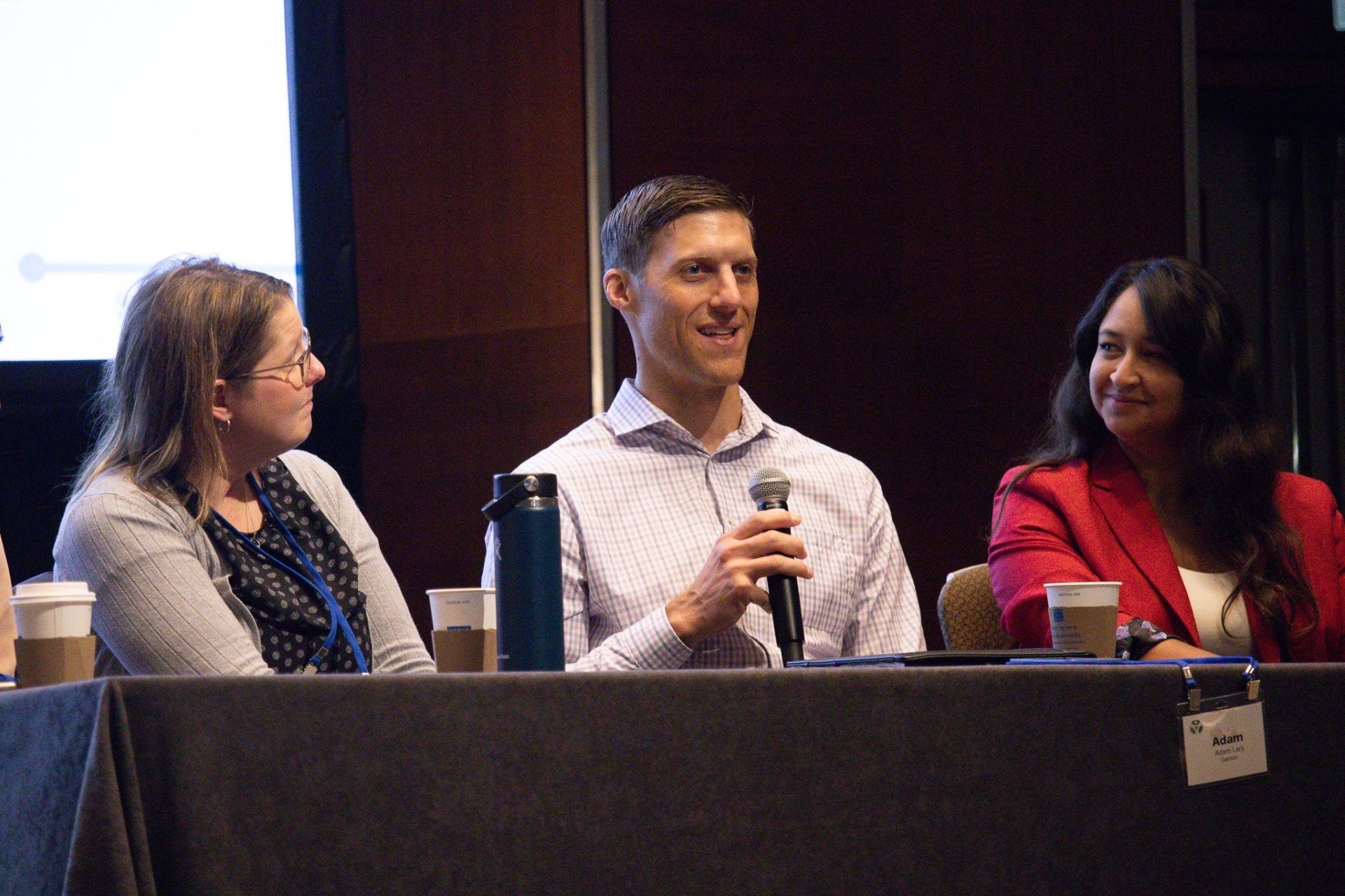
– By Anika Fairooz Shafi
Adam Lary is a Human Factors Engineer at Garmin, where he plays a pivotal role in designing and refining intuitive interfaces for flight deck avionics and pilot-support applications. A member of our ASTG group, Anika, recently sat down with Adam to discuss his unique career trajectory, his transition from the military to the aviation industry, and his perspective on the future of cockpit design.
- If you could walk me through your journey so far — what led you into human factors and ultimately to the work you are doing today at Garmin?
As a plebe (freshman) at West Point, I initially thought I was going to study chemical engineering. But I stumbled across a pamphlet advertising the Engineering Psychology program, and I thought it sounded like a great balance between my interests in hard science and math as well as understanding how people think and act. I was lucky enough to have West Point send me on a short trip to the University of Central Florida the summer before declaring my major to meet an Army officer who was completing his PhD there before coming to teach in the Engineering Psychology department at West Point. I was able to shadow him and learn more about what the human factors discipline is and how it contributes to system design. It was a great experience and led me to choose Engineering Psychology as my major.
Fast forward to 2019 when I was planning my separation from the Army, I started looking at jobs in human factors back in Kansas City where I’m from and where my wife and I wanted to move back to after I got out of the Army. At the same time, I was completing my Private Pilot certificate, and I noticed Garmin avionics in the airplane. I had grown up a few miles from Garmin’s headquarters, so I started looking to see if they had open human factors positions. They did, but unfortunately, I was passed up on my first job application, so I instead went to work at Cerner (now Oracle), an electronic health record company, as a human factors researcher performing usability studies on their EHR prototypes. I kept an eye out for new openings at Garmin though, and year and a half later, I saw another opening, applied, and got the job. I’ve been here for almost five years now.
- What does a typical day in your life at Garmin look like right now?
Garmin’s Aviation Human Factors team is at the front edge of developing and designing new interfaces and features for flight deck avionics and web and mobile applications support preflight planning and in-flight decision support. Examples of avionics include our latest G3000 and G5000 PRIME integrated flight deck. On the web and mobile side, we have our Garmin Pilot app and companion website.
In a typical day, we combine our own systems knowledge and experience as pilots (many of us are), along with other internal and external pilots and engineering subject matter experts, to extract the user needs that create the foundation for good interface design. We translate those needs, combined with human factors and design principles, into user interface mockups and supporting requirements. We then hand off those mockups and requirements to the relevant other engineering disciplines (i.e., hardware or software) to implement.
On the backside, we’ll verify that the software implementation meets the initial requirements. Depending on the novelty, complexity, and criticality of the feature we designed, we may also validate the design throughout the process using formative evaluations on early mockups or more in-depth, scenario-based flight simulations at the end, to ensure that what we built will effectively support the pilot.
Absolutely.
I think that’s one of the great things about human factors, is that it is industry agnostic.
There are of course individual differences in the end users across disciplines, but at the aggregate level, we’re still dealing in basic human psychology of perception, decision-making, human performance, and more. One great example is the work in researching the macroergonomic characteristics of high reliability organizations, like nuclear power and aviation. That work has since been expanded to healthcare. And on a personal note, I’ve gathered plenty of insight into human factors methods from cross-industry practitioners at the annual Human Factors and Ergonomics Society conference that I’ve been able to directly apply in my own work at Garmin.
- I read one of your interviews; you are both human factors engineer and a private pilot. How does being in the cockpit shape your perspective and thought process around user needs and systems design at Garmin?
It helps me in several ways. First, I think it helps sustain the passion for my work, knowing that I will find myself flying using the equipment I designed at some point, so I have a deeply vested interest in making sure it works well. Second, it helps with credibility and background knowledge when I’m conducting a usability study with other pilots. I understand the language and the acronyms they use and can relate what I see and hear to my own experience, so it helps me empathize with the pilots and use that to advocate for better designs. Third, sometimes, we have to design features with very little or vague requirements. On those days, I have to put on my pilot hat and think “what problem will this solve for me, and how would I want it to work?”, and use my knowledge, skills, and intuition to create something from scratch.
- You have had a stellar career, so it might be difficult. But if you had to pick, what is one project that you are super proud of?
I have to break this into two, because I’ve had two very different career trajectories. As an Infantry officer in the Army, my most rewarding experience was as a company commander. It was a privilege to lead soldiers in training and on deployment, and that experience has shaped me into the leader I am today.
I hope to be an example of servant leadership to the people I supervise, my peers, and those above me to show what it means to inspire, encourage, organize, and communicate effectively to achieve a shared goal.
I see management as task-oriented, while true leadership is people-oriented, and at the end of the day, it’s the people that help you accomplish your mission. I’ve witnessed firsthand how destructive poor leadership can be, and how strong leadership can help an entire organization not only succeed, but excel.
As a Human Factors Engineer, my most rewarding experience has been working on Garmin’s G3000/G5000 PRIME integrated flight deck. My primary responsibility during development was conducting evaluations with pilots in our flight simulators to discover how we can further refine and improve the user interface design and systems integration. This involved collaborating with some extraordinarily talented people from Garmin’s Flight Test team, Training team, Certification team, flight simulator engineers, and other engineering disciplines. It also involved extensive coordination with FAA and EASA (European Union Aviation Safety Agency) human factors specialists, flight test engineers, and flight test pilots for regulatory oversight of Garmin’s human factors development process. Leading such a strong team toward a shared goal of improving safety, utility, and usability for pilots has been a high point of my time here.
- There’s been a lot of discourse recently around the imminent future — that is single pilot operations. At the same time, there’s also more than ever the need for more inclusive skies. A future were individuals, for instance with limb differences, can interact with cockpit avionics using perhaps prosthetics or voice input. What are your thoughts on these two parallel possibilities, in terms of opportunities, challenges, and emerging considerations?
I can respect the operational incentives to move toward single pilot operations. Flight crew related expenses are one of the biggest costs for airlines behind fuel, so any move that can help reduce those costs will make airlines more profitable. However, I think it is directly at odds with safety outcomes. Dual crews contribute greatly to the overall national airspace system’s resilience. It’s easy to see an aircraft accident on the news, preemptively and incorrectly attribute it to human error, and make the argument that we should automate more of the cockpit and take the pilots out of the loop. But that ignores the millions of flight hours that are accomplished safely every year because skilled pilots can adapt when systems malfunction or an operation doesn’t evolve exactly as planned. The research shows the benefits effective crew resource management brings to aviation safety, and I think it would be remiss to think that the technology we have today can effectively replace a knowledgeable copilot.
An EASA report from 2025 came to a similar conclusion that single pilot operations do not provide an equivalent level of safety today compared to dual crews (here is the report: https://www.easa.europa.eu/en/research-projects/emco-sipo-extended-minimum-crew-operations-single-pilot-operations-safety-risk ). You have to consider what happens if the pilot becomes incapacitated, the added safety provided by cross-checking information and inputs between pilots, and frankly, the practical issues like what happens when the pilot needs to use the restroom? We’re just not there yet.
Instead of looking at how to replace the pilot with new technology, we should be thinking about how we can effectively integrate it at key leverage points.
And that should start from a baseline of what the technology is capable of today—not five years from now, not when the machine learning algorithm “has more training data”, not when the next accident happens and it becomes a hot-button issue on the news. Let’s see what’s out there here and now that can be used to improve safety outcomes.
- When did you join HFES ASTG and how has this helped your personal or professional development?
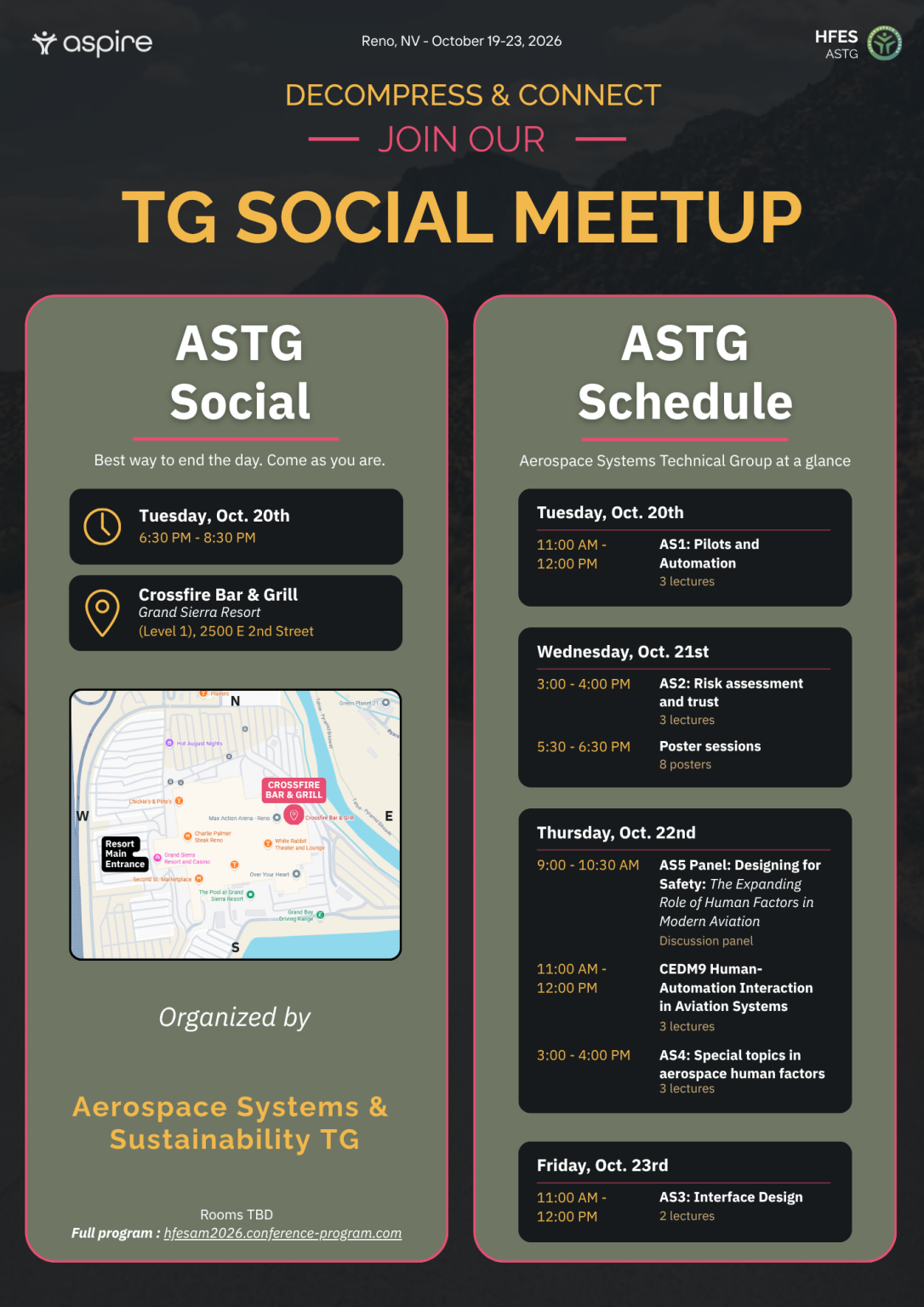
I can’t remember exactly when I joined the ASTG, but I think it was in 2021 after I started at Garmin. It’s been a great resource for networking with other aerospace professionals involved in human factors. I’ve especially appreciated the get togethers at the annual meeting where I’ve met some wonderful people.
In the last year, I’ve also noticed the ASTG’s efforts to get more information out there through regular newsletters and webinars. This has helped bring awareness to news and journal publications that I otherwise might have missed and to hear perspectives from other human factors professionals in the industry through the webinars.
- What advice would you give to someone new to HF or perhaps those doubting if HF is for them?
For someone new to human factors, I recommend getting clear about your personal and professional goals and saying yes to any opportunities that further those goals, even if it takes you out of your comfort zone. There is so much to learn out there, you have to prioritize it somehow, but once you define those priorities, saying yes is the only thing that will actually make it happen.
If you’re doubting, just think of a recent experience when you were frustrated because of a poorly designed tool or interface. It’s a silly example, but what regularly comes to mind for me is a microwave in one of our break rooms that has an automatic door lock. When your food is done heating, you have to press a separate button to unlock the door before you can get your food out. The buttons is labeled with dark red text on a black background, so it’s hard to read. There are literally directions for how to open the microwave door—but they’re on the top of the microwave, which is in sort of a cubby, so you can’t see them. People have resorted to handwriting and taping a note on the front of the microwave to push the button to open the door. The first time I used it, I felt like an idiot pulling on the door handle for what felt like several minutes before I noticed. I have refused to use it ever since, but I see it every day, and it’s a funny reminder of why I do what I do.
- Finally, what makes a meaningful career?
I think that’s different for everyone, so you have to come up with the answer that’s meaningful for you. But for me, I really value the opportunity to advocate for more intuitive and usable technology. There are plenty of interfaces out there that may look beautiful, but don’t help users achieve their goals or improve decision-making, are error-prone, or rely on clunky workarounds because no one thought about how it would be used by real people in real work environments where decisions and actions have real impact. As consumers, I think we have to demand that of the systems, products, and services we choose to spend our money on. And I like knowing I’m in a position to move the needle in that direction.






Leave a Reply